For the professional contractor or the dedicated DIY enthusiast, the "Red" brand represents more than just a tool—it represents a significant capital investment. When a high-performance M18 Fuel impact driver or a specialized MX FUEL piece of equipment fails, the immediate concern shifts from the project at hand to the protection of that investment. A common question arises in the wake of a successful warranty claim: Does the clock start over on the replacement tool?
While it is tempting to view a replacement as a "fresh start," Milwaukee Tool maintains a rigorous, data-driven policy regarding its service life and contractual obligations. Understanding these nuances is critical for managing your tool inventory and ensuring you are not caught off guard when a second failure occurs near the end of the original coverage window.
Key Verdict: Does the Warranty Reset? No. The Milwaukee warranty does not reset when you receive a replacement product. The warranty period remains strictly tied to the original date of purchase or, in the absence of a receipt, the manufacturing date code. Milwaukee views a replacement as the fulfillment of the original sales contract, not the creation of a new one.
The Concept of Warranty Fulfillment
In the world of consumer law and manufacturer policies, a warranty is essentially a promise that a product will be free from defects for a specific duration. When Milwaukee replaces a tool under warranty, they are fulfilling their side of the original bargain. From their perspective, you paid for five years of guaranteed service for a specific tool category. Whether that service is provided by one tool or three successive replacements, the total duration of the manufacturer’s liability remains the same.
If warranties reset upon every replacement, a user could theoretically maintain an "infinite tool" loop—replacing a tool every few years just before the warranty expires to gain a brand-new window of coverage. To maintain profitability and price stability, Milwaukee, like most major manufacturers in the power tool industry, utilizes a "continuous clock" system.
Breaking Down Milwaukee’s Warranty Durations by Category
To navigate the policy effectively, you must first understand the tier of coverage your specific tool falls into. Milwaukee does not apply a "one size fits all" duration; instead, they categorize tools based on expected intensity of use and internal components.
| Tool Category | Standard Warranty Duration | Key Exclusions/Notes |
|---|---|---|
| M18™ & M12™ Power Tools | 5 Years | Excludes wear and tear, abuse, or unauthorized repairs. |
| MX FUEL™ Equipment | 2 Years | Includes a specialized battery/charger coverage window. |
| Hand Tools | Limited Lifetime | Coverage for the "useful life" of the tool against defects. |
| Reconditioned Products | 1 Year | Independent of the original new-product window. |
| Heated Gear | 1 Year | Covers the heating elements and electronics only. |
| Laser Levels | 2-3 Years | Varies by model; often requires registration for the full term. |
The 1-Year Reconditioned Rule
It is worth noting the distinction for reconditioned products. If you purchase a tool that has been factory-refurbished, it carries a standard 1-year warranty. Even if this tool is a replacement for a tool that originally had a 5-year window, the replacement's lifespan is governed by the remaining time on that original 5-year window, not a new 1-year "reconditioned" term.
Specific Terms for Milwaukee Batteries
Batteries are the "fuel" of the modern job site, and they are subject to chemical degradation that tools are not. Consequently, Milwaukee utilizes a dual-metric system to track service life, which can be more complex than the standard tool warranty.
For most high-capacity M18 and V-series batteries, Milwaukee offers coverage that is measured in either years or "charge cycles." The standard threshold for many of these units is:
- 2,000 Charges or 5 Years: Whichever comes first.
- 1,000 Charges or 2 Years: For standard compact or mid-range units.
If you receive a replacement battery, the internal circuitry of that new battery will likely show zero cycles, but the legal coverage is still tethered to your original purchase receipt. If the original battery failed at year four of a five-year warranty, your replacement battery is technically only covered for the remaining one year, regardless of how many cycles you put on it.
How Milwaukee Verifies Your Warranty Status
The most common point of friction in the warranty process is the verification of the "start date." Milwaukee employs a hierarchical system to determine when your warranty began.
- Valid Proof of Purchase: A sales receipt from an authorized distributor is the gold standard. This defines the exact day the "clock" started.
- Manufacturing Date Code: If a receipt is unavailable, Milwaukee defaults to the date the tool was manufactured. This is encoded in the serial number. While this ensures you get coverage even if you lose your receipt, it often results in a shorter effective warranty period, as the tool may have sat on a distributor's shelf for six months before you bought it.
The Role of Tool Registration
While many users believe that registering a tool "locks in" the warranty, Milwaukee’s official stance is that registration is recommended but not mandatory for coverage—provided you have the receipt. However, registration serves as a vital digital paper trail. If you replace a tool, updating your digital inventory helps track the lineage of your equipment.
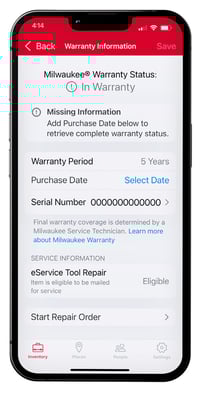
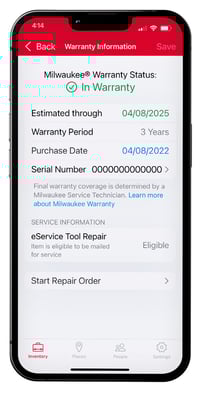
By using the One-Key app or the Milwaukee online portal, you can upload photos of receipts. In the event of a replacement, the history of that tool’s serial number is logged. If the replacement fails, the technician can see that Tool B was issued as a replacement for Tool A, and they will apply the remaining balance of the original warranty to the claim.
The Warranty Claim and Repair Process
The efficiency of the Milwaukee system is largely due to their eService Tool Repair portal. This 24/7 online solution allows you to initiate a claim, print a pre-paid shipping label (for tools under warranty), and track the repair progress.
When the tool reaches a Factory Service Center, one of three things typically happens:
- Repair: The tool is fixed using genuine Milwaukee parts. The warranty continues as normal.
- Replacement: If the tool is "Beyond Economical Repair" (BER), Milwaukee will send a new or reconditioned unit of the same or later model.
- Lightning Max Repair (LMR): For tools that are out of warranty or have suffered non-warrantable damage (like a 30-foot drop), Milwaukee offers a flat-rate repair service. It is important to note that an LMR repair usually comes with its own limited 90-day to 1-year warranty on the specific work performed, which is separate from the original manufacturing warranty.
If you are unsure where to go, Milwaukee maintains an extensive network of Authorized Service Stations. These are often local tool repair shops that have been vetted and certified to handle Milwaukee claims, providing a faster turnaround for those who cannot wait for shipping.
Strategic Advice for Owners
As a critic of industrial policy and consumer goods, my advice to Milwaukee users is to maintain a "Digital Tool Box." The moment you receive a replacement tool, do not discard the paperwork associated with the exchange. Attach the service order to your original purchase receipt.
In the rare event that a replacement tool is "Dead on Arrival" (DOA) or fails within weeks, having the documentation of the recent replacement often allows for a more favorable interaction with customer service, even if the original warranty has technically just expired. While the policy is firm, Milwaukee has been known to exercise "commercial goodwill" for well-documented cases involving premature replacement failures.
FAQ
Q: If my tool is replaced with a newer model because the old one is discontinued, does the warranty change? A: No. Even if you receive a newer, upgraded version of the tool as a replacement, the warranty expiration date remains the same as the original tool you purchased.
Q: Does the warranty cover "wear and tear" parts like carbon brushes or chucks? A: Generally, no. Items that are designed to wear out through normal use are considered maintenance items. However, if a chuck fails due to a metallurgical defect rather than grit and debris, it may be covered.
Q: What happens if I buy a Milwaukee tool second-hand? A: The warranty is technically for the "original purchaser." However, in practice, Milwaukee often honors the warranty based on the manufacturing date code found in the serial number, regardless of who currently owns the tool.