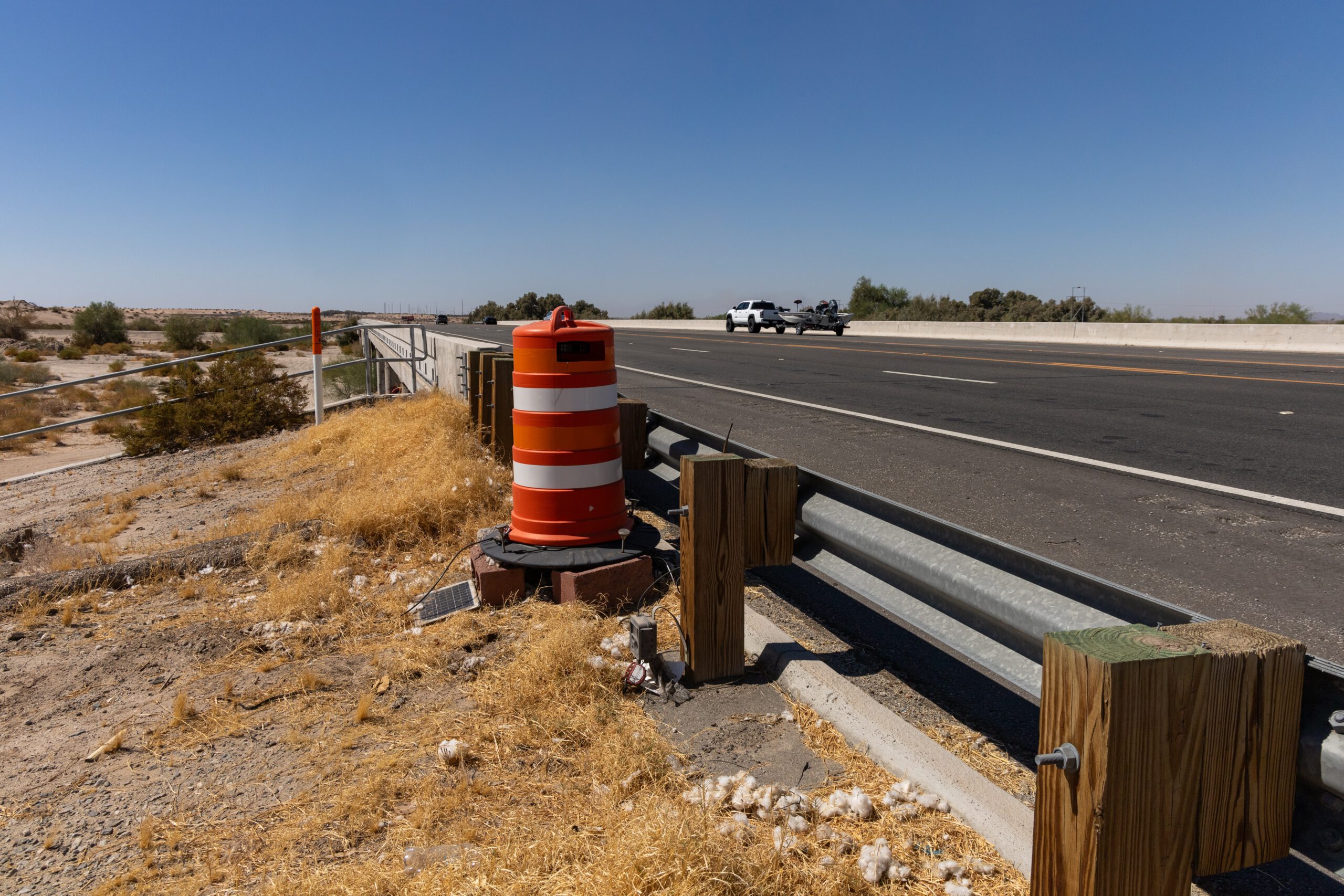
The orange construction barrel is a staple of the American commute—a signal of temporary inconvenience, a detour, or a lane closure. But for drivers in Southern California, those plastic pylons have recently taken on a much more permanent and clandestine role. Behind the reflective tape and sturdy polyethylene lies a sophisticated network of federal surveillance that most residents didn't know existed until recently.
While you might be looking for a worker with a "Slow" sign, a high-speed lens is looking at you. Privacy advocates and investigative journalists have pulled back the curtain on a covert program that transforms ordinary road equipment into "Trojan Horses" for federal law enforcement. This isn't just about catching speeders; it’s about a massive, predictive intelligence-gathering operation that tracks where you go, how long it takes you to get there, and whether your driving habits fit a computer-generated profile of a criminal.
The Reality of Stealth Surveillance
Yes, privacy advocates have identified approximately 40 automated license plate readers (ALPR) hidden inside construction barrels throughout San Diego and Imperial counties. These devices are used primarily by federal agencies, including the Drug Enforcement Administration (DEA) and Customs and Border Protection (CBP), to monitor movement patterns without public notice or local oversight.
How the 'Secret Barrel' Cameras Work
The technology at the heart of this controversy is the Automated License Plate Reader (ALPR). At its most basic level, an ALPR consists of high-speed cameras and sophisticated software that can capture images of license plates, convert them into data, and timestamp the location. While ALPRs are often mounted on police cruisers or permanent gantries over highways, the "secret barrel" program takes a much more deceptive approach.
These covert units are designed to be invisible. By integrating the cameras into standard-issue construction barrels—the kind provided by contractors or the California Department of Transportation (Caltrans)—agencies can deploy them in high-traffic areas without raising suspicion. Unlike a traditional traffic camera, which is often bulky and visible, these hidden units use small, recessed lenses that are nearly impossible to spot at 65 miles per hour.
This deployment requires a unique level of coordination. Records suggest a "handshake" agreement between state agencies like Caltrans and federal agencies like the DEA. While Caltrans manages the roadwork and the placement of barrels, the federal agencies provide the tech and harvest the data. This partnership allows federal agents to bypass the scrutiny that usually accompanies the installation of permanent surveillance infrastructure.
Predictive Intelligence: When Driving Becomes 'Suspicious'
The most concerning aspect of this program isn't just the fact that your plate is being scanned—it’s how that data is being analyzed. This isn't a passive system that only flags stolen vehicles or missing persons; it is a "predictive intelligence" program.
Federal agencies use algorithms to identify what they deem "suspicious" driving behaviors. These algorithms aren't looking for a single infraction but for patterns that deviate from the norm. For example, if you are driving from the U.S.-Mexico border to Oceanside—a trip that should take about an hour—but you take six hours to cover that 50-mile distance, the system flags you.
The logic used by the DEA and Border Patrol suggests that a "slow" trip or a circuitous route could indicate a driver stopping at a "stash house" or waiting for a hand-off of illicit goods. However, for the average citizen, a six-hour trip across 50 miles could simply mean a long lunch, a visit to a friend, or an afternoon nap at a rest stop.
The risk of "False Positives" is significant:
- Commuter Anomalies: A driver who takes a back road to avoid a major accident on I-5 might be flagged for an "unusual route."
- Frequent Trips: A local business owner who makes multiple trips to a warehouse near the border could be categorized as having a high-risk travel pattern.
- Data Persistence: Once flagged, your travel history remains in federal databases, often shared across a network of agencies (HIDTA—High Intensity Drug Trafficking Areas), potentially subjecting you to more frequent stops or "random" secondary inspections in the future.
Privacy at Risk: The Legal Contradiction
The existence of these hidden cameras has sparked a fierce legal debate, primarily because they appear to circumvent California’s strict privacy laws. In 2015, California passed SB 34, a law intended to regulate the use of ALPR data and protect the privacy of California residents. It requires agencies to provide public notice, maintain strict security, and ensure that the data is only used for specific, authorized purposes.
However, federal agencies like the DEA operate under a different set of rules. By using federal "administrative subpoenas" or simply operating under the umbrella of border security, these agencies claim they are not bound by state-level privacy restrictions.
The Electronic Frontier Foundation (EFF), alongside a coalition of civil rights groups, has recently sounded the alarm. In a formal letter to Governor Gavin Newsom, these groups argued that allowing federal agencies to plant secret surveillance devices on state-owned property—like Caltrans construction zones—violates both the spirit of SB 34 and the Fourth Amendment of the U.S. Constitution, which protects against unreasonable searches and seizures.
The argument is simple: the mass collection of location data without a warrant or individualized suspicion constitutes a "search." When that search is conducted through deception—disguised as road safety equipment—it erodes the public's trust in state infrastructure.
Surveillance vs. Safety: Distinguishing Different Camera Types
To understand why privacy advocates are so concerned about the "secret barrel" program, it is helpful to distinguish it from the traffic cameras we encounter every day. Not all roadside cameras are created equal, and the legal oversight for each varies wildly.
| Feature | Traffic Safety Cameras (Red Light/Speed) | Federal ALPR Surveillance (Covert) |
|---|---|---|
| Primary Purpose | Deterring speeding and red-light violations. | Tracking movement patterns and predictive policing. |
| Visibility | High. Usually marked with signs and visible housing. | None. Disguised as construction equipment. |
| Data Scanned | Only vehicles violating a specific law. | Every vehicle that passes the barrel. |
| Data Retention | Usually deleted within 30–90 days if no violation. | Can be stored for years in federal databases. |
| Legal Oversight | Local ordinances and state traffic laws. | Federal agency guidelines; minimal local oversight. |
As seen in the table above, the shift from safety to surveillance is profound. While a speed camera is a localized tool for enforcement, a secret ALPR is a wide-area tool for intelligence. The lack of data retention limits for federal ALPRs means your movements from 2024 could still be accessible to an investigator in 2029, even if you never committed a crime.
How to Identify and Respond to Covert Surveillance
While these devices are designed to be stealthy, they are not entirely invisible to a trained eye. Drivers who are concerned about their privacy can look for specific visual cues that distinguish a surveillance barrel from a standard safety barrel.
Visual Cues and Identification:
- The "Peephole": Look for a small, circular glass lens recessed into the side of the barrel, usually near the top reflective strip.
- Power Sources: Standard barrels are hollow and light. Surveillance barrels may have internal batteries making them appear heavier, or they may have discreet wires running to a solar panel or nearby utility pole.
- Atypical Placement: If you see a cluster of construction barrels in an area where there is no active roadwork, no machinery, and no crew, it may be a surveillance node rather than a safety zone.
- The "Solo" Barrel: Frequently, a single barrel will be placed at a strategic "choke point"—such as an on-ramp or a bridge—far away from any actual construction.
Legislative and Personal Action: The most effective way to address covert surveillance is through transparency and advocacy. As we move toward 2026, several California legislators are looking to tighten the loopholes that allow federal agencies to use state roads for secret tracking.
You can support these efforts by:
- Contacting Local Representatives: Ask for a "Surveillance Transparency Ordinance" that requires any law enforcement technology deployed on public roads to be disclosed to the public.
- Supporting the EFF: Organizations like the EFF lead the legal fight against warrantless surveillance and provide resources for citizens to track the expansion of ALPR networks.
- Public Inquiries: Citizens have the right to file Public Records Act (PRA) requests with their local city councils to see if their local police departments are sharing data with the federal agencies operating these barrels.
FAQ
Q: Is it legal for the government to hide cameras in construction barrels? A: The legality is currently a "gray area." While federal agencies claim they have the authority to monitor international borders and interstate drug trafficking, privacy groups argue that doing so without a warrant on state property violates the Fourth Amendment and California's SB 34 privacy law.
Q: Do these cameras only track criminals? A: No. These cameras are "indiscriminate," meaning they capture the license plate, time, and location of every single vehicle that passes them. The data is then filtered through algorithms to identify "suspicious" patterns, but the movements of innocent drivers are still recorded and stored.
Q: How long does the government keep my travel data? A: Retention policies vary by agency. While some local California agencies delete non-hit data after 60 days, federal agencies like the DEA and CBP often have much longer retention periods, sometimes keeping records of movement for years in massive "intelligence clouds."
Conclusion
The discovery of secret cameras in construction barrels is a stark reminder that the tools of the "surveillance state" are becoming increasingly integrated into the fabric of our everyday lives. What used to be the stuff of spy novels—cameras hidden in plain sight—is now a documented reality for drivers in San Diego and beyond.
While law enforcement argues that these tools are essential for national security and the "War on Drugs," the lack of transparency remains the primary concern. When surveillance is hidden, there can be no public debate about its merits or its limits. As we navigate the roads of 2026 and beyond, the challenge for society will be deciding where "public safety" ends and "unwarranted intrusion" begins. Until then, you might want to look a little closer at the next orange barrel you pass—it might be looking back at you.